
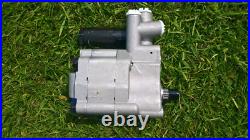
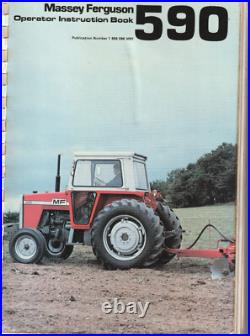
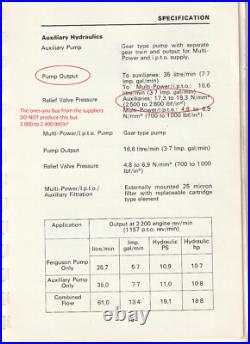
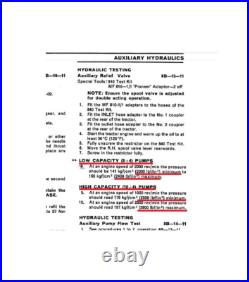
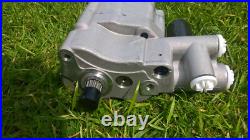
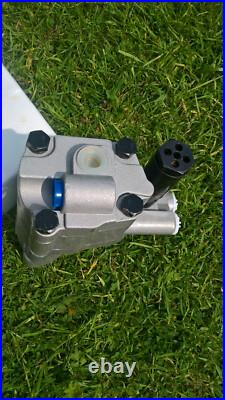
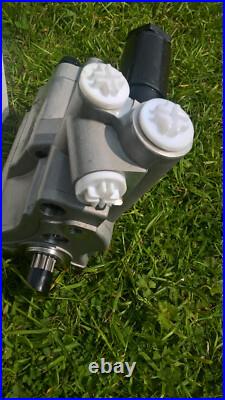
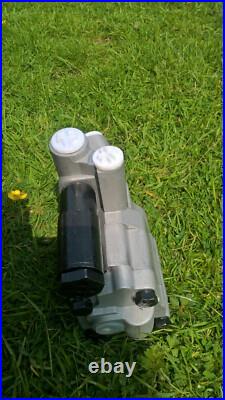
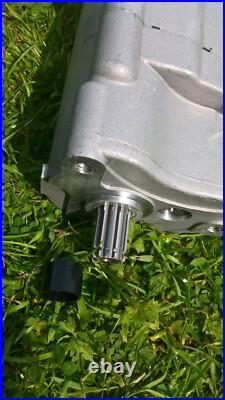
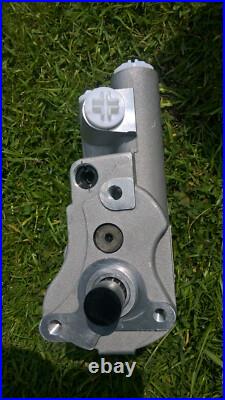

Twin intake Auxiliary Hydraulic Pump for Massey Ferguson tractors with both (i) Multipower and/or IPTO and Auxiliary Hydraulics. The pressure output matches that of the original “HIGH CAPACITY” Massey Ferguson pumps as fitted to the 500 series tractors. No one else produces to this specification. See picture above from the service manual. When fitting a new pump means splitting the tractor, you will know I have done the hard yards. I ended up making a test rig for the pumps to avoid that problem. I have tested each one of these I now supply and they are all right up at the 2,800 lbs/in². When I inquired of the very major business, could they possibly supply a pump as per the original MF specification producing 2,500 to 2,800 lbs/in² they were very good about it all. So why does the pressure matter? Surely the pumps with the lower pressure will do the job and being lower pressure it should last longer? Well that last bit is right and maybe if you are not using the hydraulics of your tractor to capacity in any way, then that all would be correct. These are high quality pumps manufactured by a company that also produces OE automotive hydraulic steering pumps for many european brands including BMW. If a beautifully restored tractor, going to shows and doing odd jobs is your goal, that pump will give you perfect service, after all that capacity pump was fitted to many Massey Ferguson tractors. The pictures show the pages from the original MF Operator Instruction Book and MF Service Repair Manual. In my case I have an MF590. My tractor is fitted with an MF80 loader. Now the specification for the loader states that it will lift 1,378kg. I want to use it to move 1,000kg (1 ton) pallets around that might be delivered by builders’ merchants or agricultural suppliers. All should be good, Yes? Similarly if you have a big bucket surely it will lift it satisfactorily? Well no, because that original MF loader specification is asterisked with a note stating that lift capacity is 1,378 kg with the oil supply at a pressure of 2,950 to 3,100 lbs/in², which is that of the main lift pump. So with my loader connected to a brand new auxiliary pump putting out 2,050 lbs/in² that lift 1378kg capacity drops to 934kg and then allow 200kg for the pallet forks and faceplate so with lift capacity is now down at around just over 700kg, it shows why my loader could get nowhere near lifting a 1 ton pallet left at the roadside for me to take in. It works, I know, because I have done it. With my bucket on my loader, again lift capacity is similarly improved. So I have obtained a small batch of pumps and they are for sale here. If you do not need the high pressure, then fine, I also ordered standard fare and I offer those at a very competitive price in my other listing. I understand most people will be quite happy with the lower pressure output, after all, higher pressure means greater wear and tear and all those hose fittings need to be maintained to the very best for the higher pressure. It is bought to fix something that is not working. So what will a new pump fix and what will it not fix. Our Massey Fergusons that use this pump have 3 hydraulic systems. 1The main lift pump which is the only pump that operates the main lift arms at the rear of your tractor and may or may not be connected to a tipping pipe and/or a selector valve which, sort of, could, possibly, at times, combine the flow with that of the auxiliary pump to the auxiliary services in some conditions. So if you have main lift arm problems, changing this pump will do nothing for that. 2 & 3 This pump which consists of two separate pumping chambers (2) & (3) with separate outlets but with two inlets which enter a single chamber from which those two separate pumps both draw their inlet oil. 2 Provides oil to a single outlet that in the case of the MF500 series was connected to 3 Kontak valves for hydraulic control of sets of quick release couplings. This is the 2,500-2,800 lbs/in² supply in question. So I have my loader connected most of the time but it might be other equipment that features hydraulic rams and motors. The quick way to check this is to put a pressure gauge mounted on a quick fit coupling into a port and operate the Kontak valve. If it give 900 lbs/in² at idle, rising to 1,300 lbs/in² with the engine flat out, like mine did, you know the pump is wrecked and needs replacing. Or, without gauges, try lifting something moderately heavy up with the loader or operating a piece of equipment that needs good pressure to its ram to work and if it does not lift/work, you know the pressure is down and you need a new pump. 3 This chamber of the auxiliary pump supplies oil to both the IPTO and multipower clutch. There are two separate ports on the pump from a common output chamber. Each port connects to each of those two services. Now the specification for the pump is that this output is in the range 700 lbs/in² minimum to 1,000 lbs/in² maximum, but that is irrelevant. You can make adapters to go into the lines and measure the active pressures and you will never see anything like that from a brand new pump because of the design of the two systems to which that chamber of the pump is connected to. The IPTO has a bleed valve in it to allow oil to flow from it so it is not a blind dead end, but continually allows oil to pass. The multipower selector valve has pressure maintaining valve within it which runs at c 200 lbs/in² (there is conflicting information in the official MF publications), when multipower is not selected. This means it allows free flow to the gearbox sump at 200lbs/in². When multipower is selected there is also leakage from the clutch and that maintaining valve still operates. If either the IPTO clutch seals or the multipower clutch seals are worn you may only see 90 to 120 lbs/in² even with a new pump. On the 500 series the “hydraulic system” warning light is simply connected to this (3) circuit and absolutely nothing else. So it may well shine, very annoyingly, at you, even after splitting your tractor and fitting a new pump if either the multipower clutch and/or IPTO clutch still leak. In my case I overhauled the IPTO clutch whilst the tractor was in lots of pieces but have yet to do the multipower clutch. With multipower not selected the light is good and never shines. A hot full day’s work, multipower selected and at idle that “Hydraulic System” failure light comes on. I only engage multipower with engine revs lightly raised and there is no problem of the light coming on and the mulltipower clutch does not slip at any times. Is this a high CAPACITY pump? No not if the full sense. The original Plessey pump 886367M96 (strict) was what was termed 10+4, where 10 is the output (2) to the auxiliaries 35 litres/min and 4 is the output (3) to the IPTO/multipower 16.6 litres/min. Yes I know that is not quite right but it is the swept volume of the two separate chambers, the different output pressures then reduce that of (2) from 10/4 x 16.6 = 41.5 to 35 L/min. The “low capacity” pump had chamber (2) at exactly twice that of chamber (3) and is termed the 8+4 pump. My 1978 590 was obviously serviced with a new pump at an early stage in its life and has a Bendix pump with a production date wk/year putting at late 1979 and that is a 8+4 pump so I think they switched quick quickly to the “Low Capacity” pumps. So the pump for sale here is an 8+4 volume pump that is producing the pressure outputs of the high capacity pump. In terms of what I wanted with my loader, the speed of operation of the new pump is hugely different to the slow movement with the old pump, even unloaded it is noticeably quicker. Put a load on it that it could actually lift, with the old pump and it was painful to observe. It did move but, at times, you needed a keen eye and be deaf to the reving engine. This is a new listing so there will be no history. For feedback on what I do, have a look at the feedback on my Bomford cables. I try and get your order away the day it comes in. I think you will be pleased. Any problems and we will cross those hurdles when we get to them. I know how long it took me to get a pump that worked like the MF handbook said it should work so I will work with you. Here are plenty of other things around the hydraulic system to go wrong as well, if you fit this and still have problems, leaking valves seals etc. The pump will be good. After that, I will try my best to pack it and get it to the courier for you but no guarantees. Prices quoted are inclusive of VAT and you will get a printed VAT invoice. Your operator instruction book should inform you. Finally, and I know it has been a long read, the 500 series has an option of the Mk3 selector valve so the question could be set: Surely if you want more pressure, simply use the selector valve (if fitted) to combine the output of the main lift pump to the auxiliaries? Well I have that and “no” is the answer. The output from the main lift pump can be directed to the auxiliaries but there is a one way valve in the selector valve that causes it to lift the arms (a counter weight) first. OK so wait for the counter weight to rise and then you will have full pressure. Well no, because “constant pumping” is constant pumping until the arms are raised when the lift pump control valve is then pushed to restrict the inlet and leak the output so the pressure from the lift pump drops away to that just required to keep the arms in place. So unless you have a counterweight AND chains to stop the arms rising all the way and keep the pump constantly pumping at the chains, AND can wait until the arms are up as far as the chains will allow before you have full lift pressure of 2,950 to 3,100 lbs/in², you will simply get the lowest of the pressure from the selector valve as the lift arm ram fills or the 2050 lbs/in² at the auxiliary pump. And when the fork blades have dipped a little and you just want to nudge them up a little, you cannot have the pressure actually drop below the lifting pressure, waiting whilst the arms take their time to rise because your load then falls off the blades. Having 2,800 lbs/in² immediately on tap for any fine adjustment is what the MF designers wanted in the first place and what is most useful to the user. This pump will do the same for your tractor and yourself. For me it is the difference between my loader usefully lifting 1 ton pallets and previously only just over 700kg.